Why AI Video Generation Costs So Much Right Now
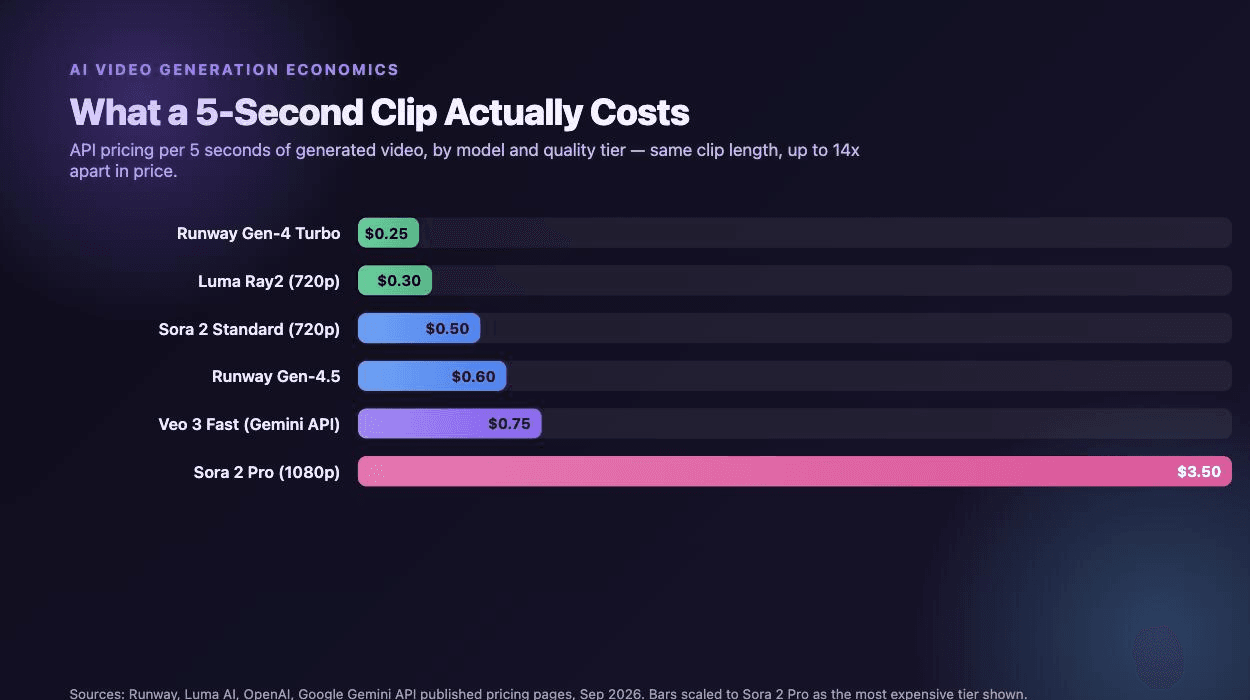
A 5-second AI video clip can cost 14 times more than another one. Even a generous-looking subscription covers barely a minute of footage a month. Here's the real math, and why prices should drop soon.
The ComparedStack Team · September 12, 2026 · 6 min read
Pay $12 a month for Runway's Standard plan and you get 625 credits. At Gen-4.5 rates, that buys you about 52 seconds of video for the whole month. Compare that to your $20 ChatGPT subscription, which covers nearly unlimited text. Video generation isn't priced like a chat app because the compute behind it works completely differently.
The cost you pay depends on the provider, the resolution, whether you want audio, and whether you're paying per second through an API or burning through a subscription's credits. Below is what a clip actually costs across the major platforms, why it's priced this way, and why you should expect the price to drop.
Why video costs more than a chat message
When you use a large language model, it generates one token at a time. Each token is so cheap that a heavy chat habit barely shows up on your monthly bill. Video works differently. One second of footage at 24 to 30 frames per second is dozens of full-resolution images that all need to match each other: same character, same lighting, same camera angle. A diffusion model builds each frame through many denoising steps, and every frame has to stay consistent with the ones before it. That's why providers charge you per second of video instead of per prompt. Your cost tracks how much footage you actually render, not how clever your prompt was.
| Plan | Price | Credits/mo | Roughly buys you |
|---|---|---|---|
| Runway Standard | $12/mo | 625 | ~52s of Gen-4.5, or ~125s of Gen-4 Turbo |
| Runway Pro | $28/mo | 2,250 | ~187s of Gen-4.5 |
| Runway Max | $76/mo | 9,500 | ~791s (~13 min) of Gen-4.5 |
| Luma Plus | $30/mo | 10,000 | ~100 five-second 720p Ray2 clips (~8 min) |
| Kling Free | $0 | 66/day | ~6 standard-mode clips per day |
Runway, Luma AI and Kling AI published pricing and credit-cost pages, September 2026. Failed generations still spend credits on most platforms.
What this means for a real project
Say you want a 30-second promo built from six 5-second clips, using the same script and shots, run through different models. On Runway Gen-4 Turbo, you'd pay about $1.50. On Veo 3's standard tier, you'd pay closer to $12. On Sora 2 Pro at 1080p, you'd pay about $21. Your prompt didn't change. The only variable was which model and resolution tier you picked, and that alone creates a 14 times price gap. Revisions make this worse: regenerating one clip means paying for the whole clip again. You can't edit a small part of a rendered video, so any fix means starting over.
Expect prices to drop
These prices typically don't last long. LLM API prices fell 10 to 100 times over a few years as providers found cheaper ways to run inference: quantized models, distilled models, and dedicated chips all cut the cost of a token. Image generation dropped in price the same way. Early diffusion models needed 50 steps per image. Newer distilled models need one to four steps and produce similar quality with a fraction of the compute.
Video generation is showing the same drop already. Runway's Gen-4.5 Turbo costs less than half the credits of full Gen-4.5 for similar output, and that's a real efficiency gain inside one company's product line, not a temporary discount. Five providers, Runway, Luma, Kling, OpenAI, and Google, are competing on price and quality right now. Providers haven't applied most of the tricks that cut image-generation costs to video yet. Once they do, expect your costs to fall.
Bottom line
Video generation costs more than text or single images because rendering many consistent frames takes more compute. Providers aren't inflating prices for the sake of it. The cost comes from a real technical constraint. But compute costs keep falling across this industry, and video generation is early in that cycle. If today's numbers stretch your budget, check them again in a year. They'll likely be lower.